Da Lat: Pine Forest, Art Deco and the Coldest Coffee Country in Vietnam
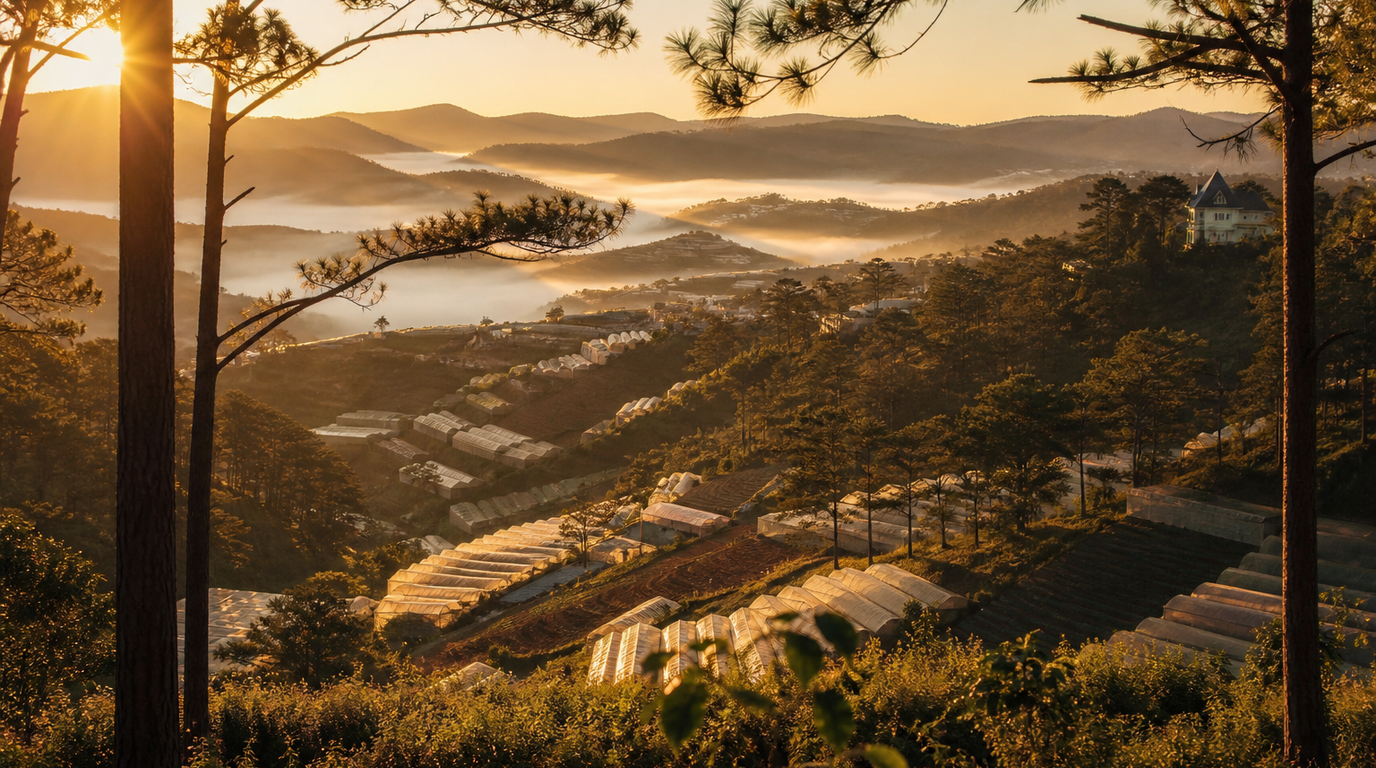
The first thing Da Lat does is make you reach for a jacket. You climb out of the Mekong heat, up through pine forest on a road that keeps switching back on itself, and somewhere around the fifteen-hundred-metre mark the air turns cool and resinous and the light goes thin and clear. The French noticed this in the 1890s, when the bacteriologist Alexandre Yersin crossed the Lang Biang plateau and reported back that here, finally, was somewhere in Indochina a European could breathe. What they built became a hill station of villas, a lake and a golf course, and although the villas are now guesthouses and the golf course has company, the essential proposition has not changed in a century. Da Lat sits at roughly 1,500 metres and holds between fifteen and twenty-five degrees more or less all year, which is why Vietnamese honeymooners, strawberry farmers and anyone escaping a Saigon April all end up here.
The colonial inheritance is still the easiest thing to see, and the most photogenic. Xuan Huong Lake curves through the middle of town, a crescent of water made by damming a stream in 1919, with a walking path that takes about an hour and passes swan pedalos of the kind that seem legally required at Vietnamese lakes. Above it stand the ochre villas, some restored into hotels, many not. The 1938 railway station is the finest art deco building in Vietnam, with three steep roofs said to echo the peaks of Lang Biang, and although the line to Phan Rang has long been abandoned, a short heritage stretch still runs seven kilometres to Trai Mat and the extraordinary Linh Phuoc Pagoda, whose every surface is mosaicked in broken porcelain and beer-bottle glass. The other essential building is nothing to do with the French at all: the Hang Nga guesthouse, universally called the Crazy House, a concrete fantasia of tunnels and giant tree trunks designed by an architect who happens to be the daughter of a former Vietnamese president.
What is easy to miss is that Da Lat is first and foremost farmland, and the best of it is edible. The plateau's cool nights and volcanic soil grow things that will not grow elsewhere in Vietnam — strawberries, artichokes, avocados, and hillside after hillside of flowers under plastic that glows at dusk like a landing strip. The highlands around Cau Dat are one of the few places in Vietnam where arabica is grown rather than robusta, which means the coffee here is brighter and more acidic than the dark, condensed-milk-sweetened cups of the lowlands, and the better roasters in town will pour it black and expect you to be pleased about it. In the evening the market spills down the steps into the square and turns into a griddle: banh trang nuong, the rice-paper round that everyone calls Da Lat pizza, hot soy milk served in glasses, and kem bo, avocado ice cream, which sounds wrong and is not.
The reason to stay a third night is everything outside town. Datanla waterfall has become the country's main canyoning centre, where a day of abseiling down wet rock and jumping into pools costs a fraction of what it would anywhere else, and the tamer alternative is an alpine coaster you drive yourself down through the trees. Elephant Falls further out is louder and less managed; Lang Biang mountain gives the plateau's best view for a two-hour walk; and the Truc Lam Zen monastery is reached by a cable car that floats over pine forest for two and a half kilometres. On timing, the dry season runs from November to March and the rains arrive properly between May and October, usually as a heavy late-afternoon hour rather than an all-day washout. Lien Khuong airport is thirty kilometres south with connections to the major cities; the bus from Ho Chi Minh City takes six to seven hours and the one from Nha Trang about four, climbing the whole way.
Plan Your Vietnam Adventure
Discover our curated tours and airport services for a seamless travel experience.